 Technology24 May 2026
The Universe Is Home to ‘Impossible’ Black Holes: New Findings Unveiled
New research unveils that many hefty black holes are formed by merging smaller ones, defying previous astrophysical theories.
The Recycling Nature of Black Holes
An international team of astrophysicists has made a groundbreaking discovery about black holes, contending that the universe engages in a form of recycling by merging existing black holes to form larger, so-called ‘second-generation’ black holes. This revelation casts doubt on previous assumptions about how these massive cosmic giants originate.
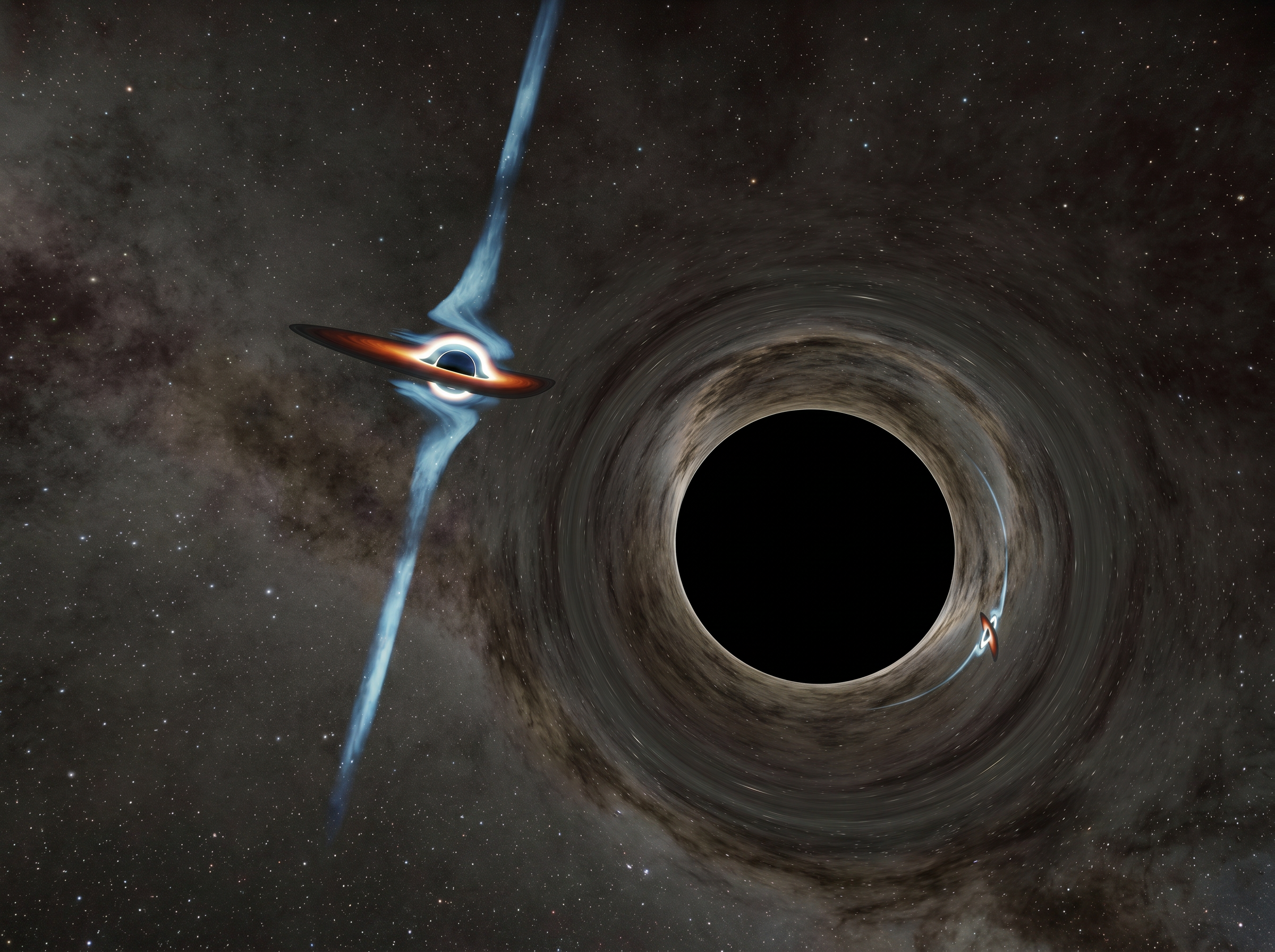
Through the analysis of gravitational waves detected over recent years, researchers found that many of the heaviest black holes, previously deemed ‘impossible’ by conventional physics, are likely products of earlier collisions rather than originating solely from the collapse of massive stars. This research stems from an analysis of 153 detected black hole mergers, which uncovered distinct population patterns that imply these gargantuan black holes are formed through repeated mergers occurring in dense stellar environments.
Understanding Impossible Black Holes
Black holes, as understood through the evolutionary theory of stars, are formed when the cores of the most massive stars collapse under their own gravity, resulting in a point of extreme density that curves space-time infinitely. Typically, this results in classic black holes with masses ranging from 10 to 40 times that of our sun. At the opposite end are supermassive black holes located at the centers of galaxies, with masses that can reach millions or billions of solar masses.
However, a mysterious category exists between these two extremes — black holes with masses between 40 and 100 solar masses. These are regarded as too heavy to emerge from the death of a singular star yet not massive enough to be formed from the collapse of a vast cloud of gas. Due to their peculiarities, conventional astrophysics has labeled them as ‘impossible’, yet evidence from gravitational wave detections indicates they are present.
The Role of Gravitational Waves
Astrophysicists suggest these massive black holes may arise from the merging of two or more smaller, ultradense black holes. Although this theory was proposed prior to the advent of gravitational wave astronomy, concrete evidence was elusive. The breakthrough came in 2015 with the first detection of gravitational waves, resulting from a black hole merger, which set off a cascade of discoveries about the frequency and nature of these mergers.
The recent study, published in Nature Astronomy, delves into a catalog of gravitational waves recorded by the world's top three observatories. The analysis focused on 153 confirmed black hole mergers and drew attention to 34 particularly heavy objects. By comparing various signals, the researchers identified two distinct populations of black holes.
The lighter black holes, weighing up to about 40 solar masses, exhibited small and aligned spins, aligning with expectations for objects birthed from stellar collapse. Conversely, heavier black holes—those exceeding approximately 45 solar masses—displayed chaotic spins that are characteristic of objects that have undergone previous mergers. According to Isobel M. Romero-Shaw, coauthor of the study from Cardiff University, “This is the exact signature you would expect if black holes repeatedly merged into dense stellar clusters.”
Conclusions and Implications
While researchers have yet to observe these ‘impossible’ black holes directly, they have identified their presence through the unique vibrational signatures left behind in space-time during their collisions. Unlike their supermassive counterparts, which can be detected through x-rays or visible light, these massive black holes elude direct observation.
The insights from this research illustrate that the heaviest black holes are not created but rather assembled through a series of mergers, often occurring in the densest environments of the universe—a radical shift in our understanding of black hole formation.
Popular news
Rising tensions in the Strait of Hormuz as U.S. claims 100 vessels redirected by blockade against Iran’s new territorial claims.





Subscribe to
our news
Get the most important updates and top stories in your inbox.